
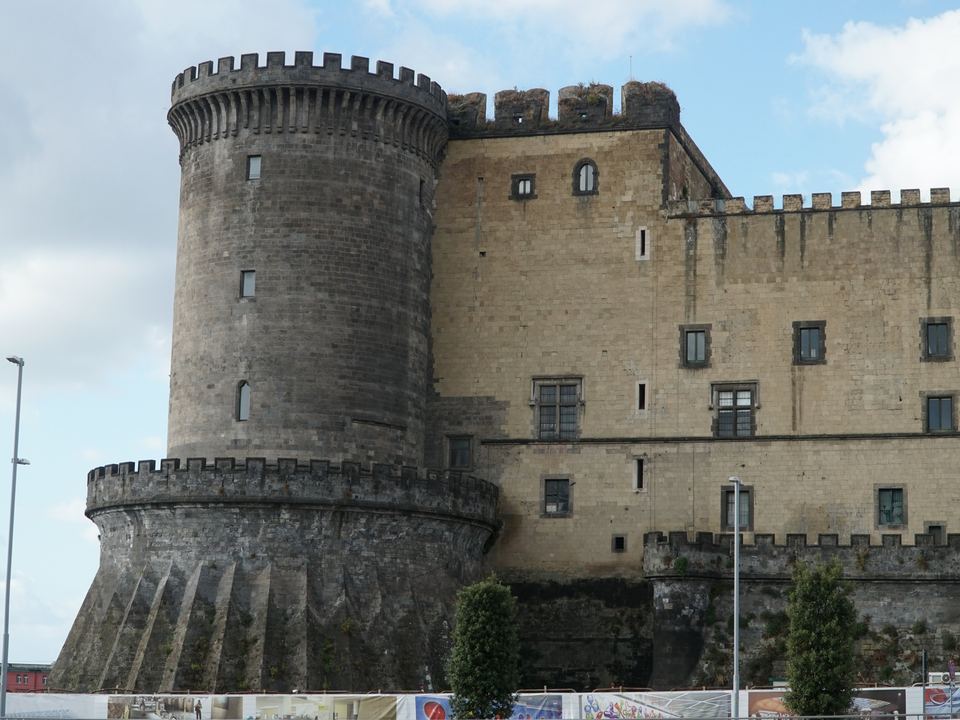
Castel Nuovo
- Castle & Fortress
- Price: €10 - €15
- Opening hours: 09:00 - 18:00 (closed Sun)
Book a guided tour of Napoli
Skip the line and see Napoli with a local guide.
History
When Charles I of Anjou broke ground on his new seaside fortress in 1279, the design and construction were entrusted to two French military architects, Pierre de Chaulnes and Pierre d'Angicourt, though the sixteenth-century biographer Vasari later credited the Pisan sculptor Giovanni Pisano instead. Whoever set the plan, the result was a compact Gothic stronghold on an irregular quadrilateral layout, its four corner towers, high crenellated curtain walls and deep encircling moat completed in barely five years, by 1282.
That Angevin core survived largely intact until Alfonso of Aragon's conquest of the kingdom in 1442, when he handed the rebuilding to Guillem Sagrera, a Majorcan architect who reshaped the fortress in a distinctly Catalan idiom — round towers, dramatic open "Catalan" stairways and floors laid with blue-and-white majolica tiles imported from Valencia — much of which still defines the castle's interior today. The Sala dei Baroni, at the heart of that Aragonese remodeling, has never fully left public life: alongside its role as a museum space, it still occasionally hosts sessions of the Naples city council, a rare case of a medieval throne room continuing to serve as a working seat of government.
Did you know?
The bronze door on the castle's south front, cast around 1474-75 by the sculptor Guglielmo Lo Monaco for King Ferrante, carries an actual cannonball lodged in one of its lower panels. According to the story handed down with the door, French troops carried it off as war booty after sacking Naples in 1495, only for their ships to be intercepted off Rapallo by a Genoese fleet; a cannonball struck the door mid-battle and stuck fast in the bronze, and the Genoese later shipped the door — cannonball and all — back to Naples, where it is now displayed inside the Museo Civico.
For generations, Neapolitans told of a crocodile that lived in the castle's underground cells, said to drag condemned prisoners down through a hidden passage to the sea; a stuffed crocodile hung for decades near the Triumphal Arch as if to prove the tale. In 2020, a team of researchers extracted DNA from a root left in the specimen's jaw and ran radiocarbon dating alongside it: the animal turned out to be a genuine Nile crocodile, Crocodylus niloticus, dating from sometime between 1296 and 1419 — squarely within the castle's Angevin and early Aragonese centuries. The most plausible explanation now on offer isn't a prisoner-eating monster at all but a soldier's ex-voto, a taxidermied crocodile brought home from Egypt as a curiosity or offering; the darker story of prisoners dragged off to sea appears to be a later embellishment.
Good to know
Castel Nuovo opens 09:00-18:00 Monday to Saturday and is closed on Sundays, with the ticket office generally stopping sales around half an hour before closing; admission, in the €10-15 range, covers the Palatine Chapel, the Armoury with its glass-floored view of excavated remains below, and the Museo Civico's picture gallery on the upper floors.
The white marble Triumphal Arch faces west across Piazza Municipio, so the softest, most even light for photographing its relief carving comes in the morning or on an overcast afternoon, before the sun swings around directly behind it. The castle sits within easy walking distance of Naples' other grand set-pieces — the Teatro San Carlo, Galleria Umberto I and the Palazzo Reale are all a few minutes away on foot — making it a natural first or last stop on a walk through the historic center.