
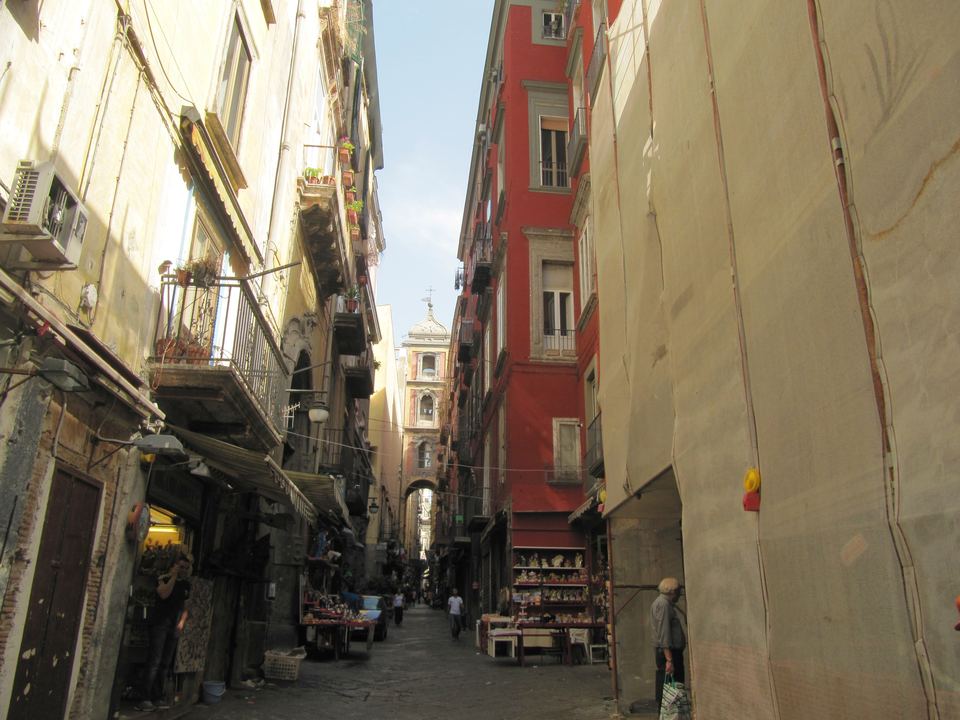
Via San Gregorio Armeno
- Historic District
- Price: Free
- Opening hours: Always open
Book a guided tour of Napoli
Skip the line and see Napoli with a local guide.
History
Tradition places the founding of the convent on this site in the eighth century, when a group of Basilian nuns fled Constantinople during the Byzantine campaign against the veneration of icons, arriving in Naples with relics of Saint Gregory the Illuminator, the first patriarch of Armenia. They settled on ground already associated with the ancient temple to Ceres, and, according to local legend, the exact spot was chosen almost by accident: during the funeral procession of a Neapolitan duke, the ox-cart carrying his body is said to have come to an unexplained halt on this very street, an omen the nuns took as a sign of where to build.
The complex grew over the centuries into one of the city's wealthiest and most influential female monasteries, largely rebuilt in its present Baroque form during the seventeenth century, complete with a cloister centred on a marble fountain and a bell tower raised on an arch spanning the street itself, still one of the most photographed details of the old town. Alongside the relics of Saint Gregory, the church also came to house those of Santa Patrizia, a Byzantine princess venerated as a co-patron of Naples, whose cult layered itself over time onto a street already filling with craft workshops.
Did you know?
Twice a week, tradition holds, a reliquary said to contain the blood of Santa Patrizia liquefies before the faithful inside the church, a phenomenon Neapolitans associate first with San Gennaro but which is claimed here too, on a different and more frequent schedule than his own famous miracle. Beneath the cloister, a well once connected to the tunnels and cisterns of what is now known as Napoli Sotterranea, reportedly used as an escape route in times of siege, a reminder that the convent's quiet garden sits atop the same layered underground city that runs beneath much of historic Naples.
The nativity-figure trade the street is famous for today is a relatively late arrival, taking off only in the second half of the eighteenth century, when the Bourbon court's own passion for elaborate presepi turned figure-making into a citywide craft industry. The workshop of the Ferrigno family, still trading from the same address on the street since 1836, is among the oldest continuously run of these ateliers, its heads still modelled in polychrome terracotta with glass eyes, in a technique passed down largely unchanged across four generations.
Good to know
The street is open around the clock and free to walk, but the workshops themselves keep shopkeepers' hours, generally open through the day and into the evening. The run-up to Christmas, from late November through early January, is by far the busiest and most festive stretch, when the lane fills with shoppers and the figures on display expand to include the year's footballers, politicians and other passing celebrities alongside the traditional shepherds and Holy Family.
Via San Gregorio Armeno branches directly off Spaccanapoli partway between Via San Biagio dei Librai and Piazza San Domenico Maggiore, making it easy to fold into a longer walk through the old centre alongside the Duomo and the complex of San Lorenzo Maggiore. Mornings, before the tour groups arrive, are the quietest time to browse and photograph the workshops, and it's worth asking before photographing inside a bottega up close; most artisans are glad to talk about their craft if you're not simply pointing a camera at them.