
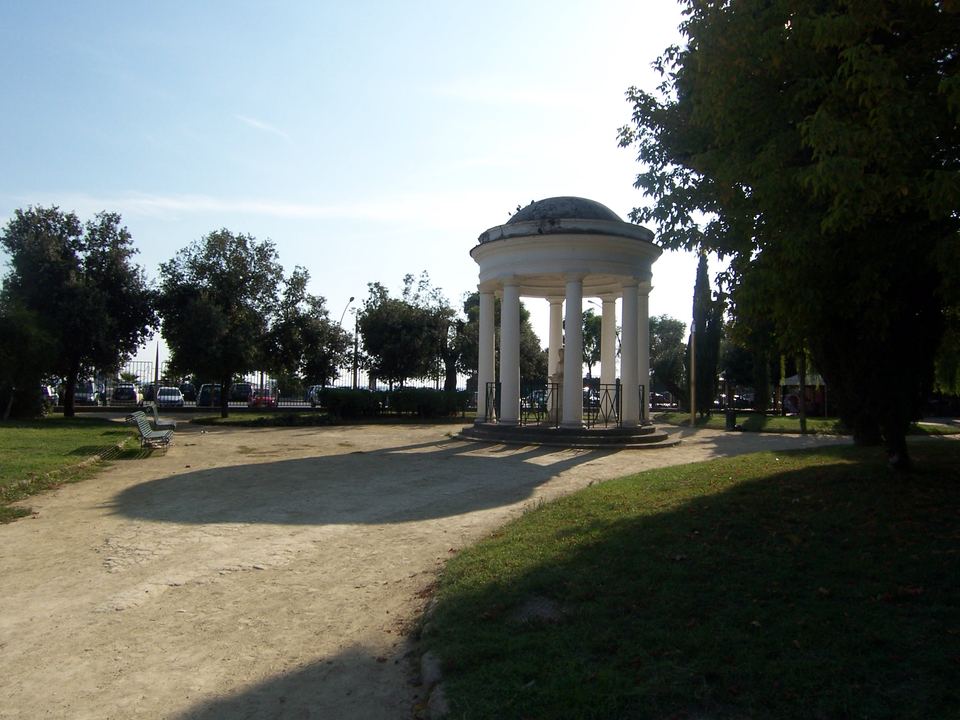
Villa Comunale
- Park & Nature
- Price: Free
- Opening hours: 07:00 - 22:00 (until 24:00 from May to October)
Book a guided tour of Napoli
Skip the line and see Napoli with a local guide.
History
The garden's origins reach back further than its Bourbon layout: as early as 1697 the Spanish viceroy, the Duke of Medinaceli, planted a double row of trees along the Riviera di Chiaia and set thirteen small fountains among them, an early seafront promenade that Neapolitans had already taken to calling their villa. It was King Ferdinand IV who transformed that modest avenue into a proper royal garden, commissioning the architect Carlo Vanvitelli, son of Luigi Vanvitelli, who had designed the royal palace at Caserta, to lay it out between 1778 and 1780 with the help of the royal gardener Felice Abbate. The finished Villa Reale, as it was then known, opened on 11 July 1781, running from what is now Piazza Vittoria to the site of today's Cassa Armonica.
For most of the 18th and 19th centuries entry was restricted to the court and the city's aristocracy, who strolled among neoclassical statuary drawn from the Farnese collection, among them Flora, Hercules and, most famously, the colossal Farnese Bull group, installed here soon after the garden opened and kept at its centre until 1824, when it was moved indoors to the royal museum, today's Museo Archeologico Nazionale, to spare it further damage from sea air and weather. The garden opened its gates to the general public only in 1869, under the newly united Kingdom of Italy, becoming, as its new name Villa Comunale made explicit, the property of the whole city rather than the crown.
Did you know?
The Farnese Bull that once stood at the garden's heart is worth a detour of its own: carved in antiquity from a single colossal block of marble and rediscovered in Rome in the 16th century, it's the largest sculptural group to survive from the ancient world, and the decades it spent in the open air of the Villa Comunale left a visible mark of weathering that conservators can still point to today, even after two centuries indoors. A pair of stone lions that once flanked its fountain here gave the spot its old nickname, the Fontana dei Leoni, long after the bull itself had moved on.
The Stazione Zoologica tucked inside the garden has a reputation reaching well beyond Naples: founded by the German naturalist Anton Dohrn, who persuaded the city to lease him the land for free in 1872, it houses what's recognised as the oldest public aquarium in Italy, its tanks still fed by the same kind of direct seawater channel devised for the original 19th-century building. More than twenty Nobel laureates are said to have worked in its research laboratories in the century and a half since, drawn by a marine-biology tradition that effectively began in this seafront garden.
Good to know
The gardens are free and open every day, roughly from 7am to 10pm in winter and until midnight in the warmer months from May to October, running for over a kilometre along Via Caracciolo between Piazza Vittoria and Mergellina. The Stazione Zoologica's aquarium, inside the park, is the one part of the Villa Comunale that charges admission, keeping its own separate opening hours and a modest ticket price, so it's worth timing as its own stop rather than folding it into a quick stroll.
Shaded avenues of holm oaks, palms and stone pines make the villa one of the coolest places to walk in central Naples on a hot afternoon, and the wide promenade along Via Caracciolo gives an open view across the gulf to Vesuvius that's especially good around sunset. It sits within easy walking distance of Piazza Vittoria, the Lungomare and Mergellina, so it folds naturally into a longer seafront walk rather than requiring a special trip of its own.