
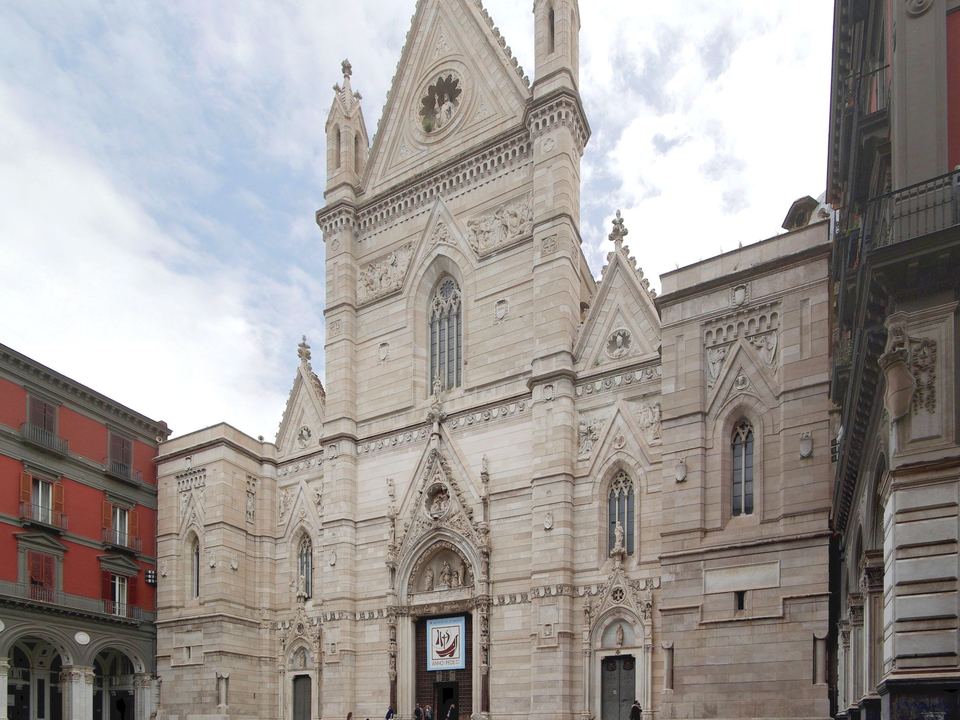
Naples Cathedral
- Church & Religious Site
- Price: Free
- Opening hours: 08:30 - 19:30
History
Naples Cathedral's Angevin Gothic core rose over a cluster of paleochristian basilicas that had stood on the site for centuries, construction begun under Charles I of Anjou in the final decades of the 13th century and carried forward by his successor Robert of Anjou into the 14th. Absorbed into the complex is the Basilica of Santa Restituta, and within it the Baptistery of San Giovanni in Fonte, founded by Bishop Severus between the late 4th and early 5th century and generally reckoned the oldest surviving baptistery in the Christian world; its small octagonal dome still glows with fifth-century mosaics worked in rare cobalt-blue glass, showing the Traditio Legis, the Wedding at Cana and the Samaritan Woman at the Well.
The medieval facade suffered badly across the centuries: sculptor Antonio Baboccio added an elaborate portal in 1407, carving figures of Saints Peter and Januarius alongside a kneeling portrait of Cardinal Enrico Minutolo beneath Tino di Camaino's earlier Madonna and Child, but the earthquake of 1456 cracked walls and toppled towers badly enough to force major rebuilding. What greets visitors on Via Duomo today is largely a 19th-century remake: architect Enrico Alvino redesigned the facade in Neo-Gothic style between 1877 and 1905, taking care to reset the surviving medieval portal and its sculptures into the new stonework rather than replace them.
Did you know?
Tradition holds that the blood of San Gennaro, bishop of Benevento martyred under Diocletian around the year 305, was gathered by a woman named Eusebia at his execution and later reunited with his relics; the ampoules themselves are thought to have been sealed away with his bones in the 9th century and brought to Naples only in the 13th. The earliest solid written record of the liquefaction itself dates to 17 August 1389, during a famine, when chroniclers described the dried substance in the vial turning to liquid before an astonished crowd — a phenomenon that has never been definitively explained by science and is still watched for three times a year.
The lavish chapel built to house the relic exists because of a literal contract: on 13 January 1527, with plague ravaging the city, the people of Naples gathered before a notary and formally vowed to build San Gennaro a grander shrine if he interceded to end the epidemic. It took the better part of a century to make good on the promise — construction under architect Francesco Grimaldi only ran from 1608 to 1637 — and Neapolitan tradition still treats a sluggish or absent liquefaction as an unwelcome omen for the city, a superstition that outlived the plague it was born from by five centuries.
Good to know
The cathedral itself is free to enter and open daily from 08:30 to 19:30, but the Treasure Chapel, its museum, and the Santa Restituta and baptistery complex are ticketed separately — worth budgeting extra time and a few euros for, since the oldest mosaics in Naples are otherwise easy to miss. As in any working church in the city, shoulders and knees should be covered.
Crowds swell hardest around the three annual dates when the blood is expected to liquefy — the Saturday before the first Sunday in May, 19 September and 16 December — so an early-morning visit on any other day is the surest way to see the Treasure Chapel in relative quiet. The cathedral sits an easy walk from the Pio Monte della Misericordia and San Domenico Maggiore, making it a natural anchor for a morning spent along Via Duomo and Spaccanapoli.