
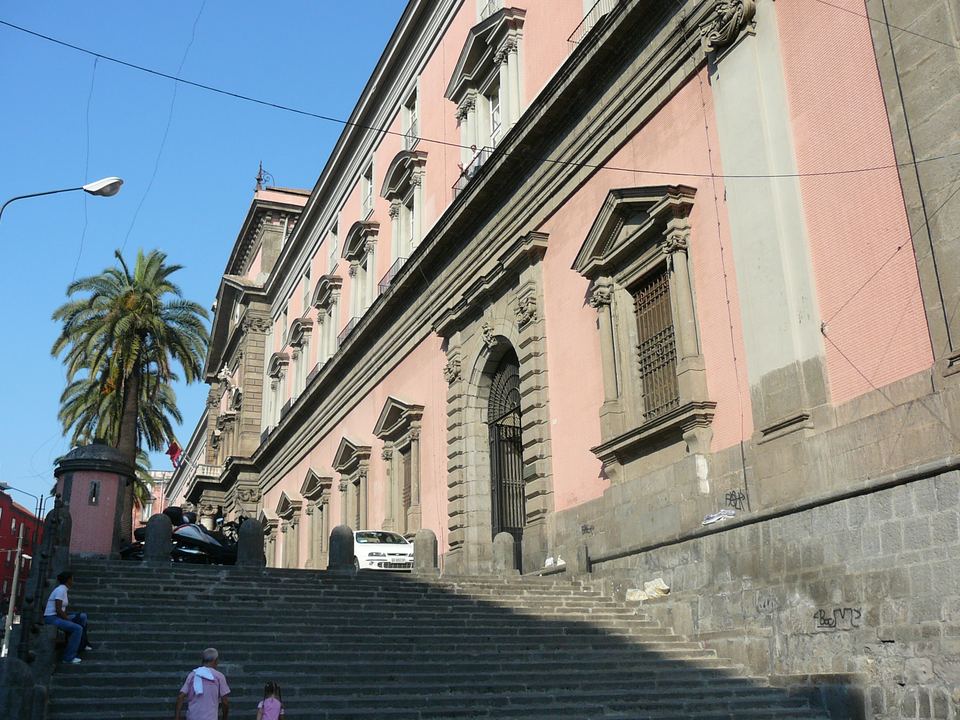
National Archaeological Museum of Naples
- Museum
- Art Museum & Gallery
- Price: €2 - €20
- Opening hours: Wed-Mon 09:00-19:30, closed Tue
History
The palazzo that houses the museum began life at the end of the sixteenth century as a barracks for the viceroy's cavalry, and from 1616 it served as the seat of the University of Naples for over a century and a half. When the university relocated in 1777, King Ferdinand IV commissioned the architects Ferdinando Fuga and Pompeo Schiantarelli to convert and enlarge the building into a purpose-built repository for the Farnese antiquities he had inherited and for the trove of finds already emerging from Herculaneum, excavated since 1738, and Pompeii, under excavation since 1748. Moving the Farnese marbles themselves from Rome proved a slower affair: transfer of the collection only began in 1787, over the objections of a papacy reluctant to see it leave the city.
The first galleries were arranged during the so-called French decade of 1806-1815, when Naples was ruled first by Joseph Bonaparte and then by Joachim Murat, but the museum only opened formally as the Real Museo Borbonico after the Bourbons returned to the throne in 1816. It took its present name, the Museo Archeologico Nazionale, after Italian unification in the 1860s, by which point it had become the single institution uniting two very different inheritances: two centuries of Farnese collecting in Rome and Parma, and the still-unfolding excavation of the cities buried by Vesuvius in AD 79.
Did you know?
The Farnese Bull, carved from a single block of marble and standing some 3.7 metres tall, is generally reckoned the largest sculptural group to survive from antiquity; ancient sources credit it to the Rhodian sculptors Apollonius and Tauriscus, and the Roman-era copy now in Naples was unearthed amid the ruins of the Baths of Caracalla in the mid-1540s. Its neighbour, the Farnese Hercules, tells its own story of restoration: when the statue surfaced missing its lower legs, the sculptor Guglielmo della Porta carved replacement calves, and it was only decades later that the original ancient legs turned up in the Borghese collection in Rome and were finally reattached; both sets can still be compared side by side in the gallery today.
For most of the nineteenth century, the museum's collection of erotic art and objects from Pompeii and Herculaneum was locked away in a so-called Gabinetto Segreto, access to which required special permission from the museum director and was, in practice, granted almost exclusively to adult men judged of sufficiently "proven morality". The Bourbons walled off the entrance entirely after the upheavals of 1848, and it was only in April 2000 that the collection was reopened permanently to the general public, with minors still required to visit accompanied by an adult.
Good to know
The museum keeps long hours, Wednesday to Monday from 9:00 to 19:30, and is closed on Tuesdays as well as on 1 January and 25 December; standard admission sits in the €2-20 range depending on exhibitions and reductions, and entry is free on the first Sunday of every month, when queues build early. Tickets can be booked online in advance, which is worth doing in high season given the museum's popularity with visitors heading to or from Pompeii and Herculaneum.
The museum sits at the top of Via Toledo on Piazza Museo, a short walk or one stop on the metro from the historic centre, making it easy to combine with a morning at San Lorenzo Maggiore or the Naples Duomo. Because so many of its Pompeian and Herculaneum finds were removed from their original context, many visitors find it rewarding to see the museum either just before or just after visiting the excavations themselves, when the frescoes and mosaics on display can be mentally slotted back into the houses and streets they came from.