
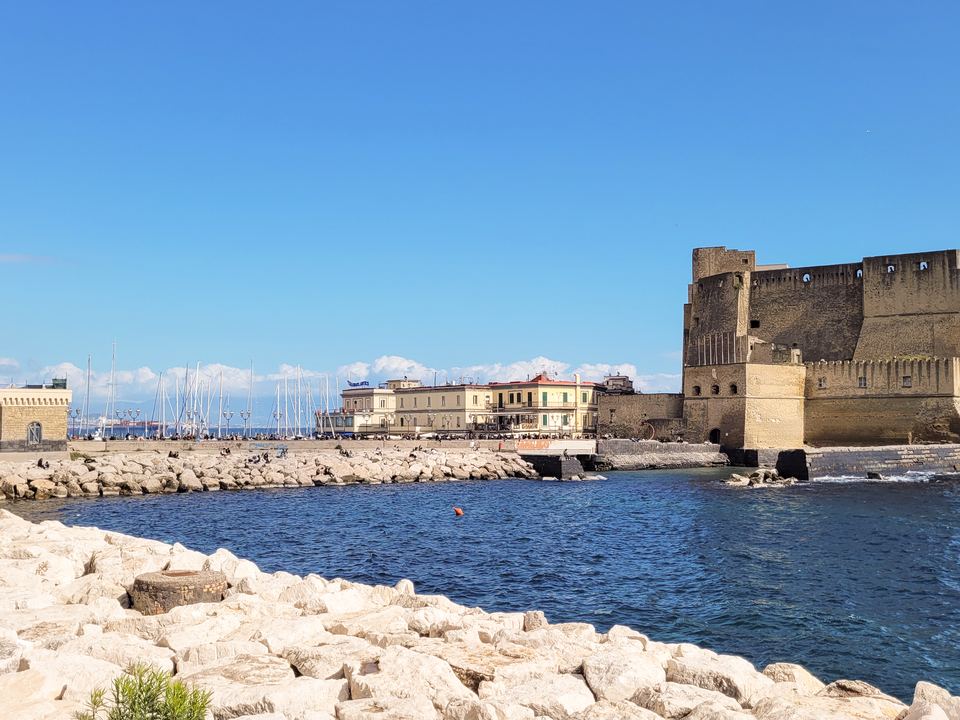
Castel dell'Ovo
- Castle & Fortress
- Price: Free
- Opening hours: 09:00 - 19:00 (Mon-Sat), 09:00 - 14:00 (Sun)
Book a guided tour of Napoli
Skip the line and see Napoli with a local guide.
History
Frederick II of Hohenstaufen, who inherited the fortress along with the rest of the kingdom, treated it as both a residence and a stronghold for the royal treasury, reinforcing it around 1222 with new towers built under the direction of the sculptor-architect Nicola Pisano. When the Angevins took the kingdom in 1266 and Charles I moved the royal court to his new fortress at the port, Castel Nuovo, the treasury and much of the royal family stayed behind at Castel dell'Ovo, still considered the more impregnable of the two.
That reputation made it a natural prison as well as a stronghold. Its most poignant Angevin-era captive was Conradin of Hohenstaufen, the last direct heir of Frederick II's line, held here as a sixteen-year-old after his defeat at the Battle of Tagliacozzo in 1268, in the final act of the Hohenstaufen dynasty's fall from power in southern Italy. The Aragonese kings who followed in the fifteenth century kept up the tradition, using the castle's cells to hold political rivals of Alfonso I even as they strengthened its outer defenses.
Did you know?
According to the legend recorded in the 14th-century Cronaca di Partenope, the Roman poet Virgil — remembered in medieval Naples less as a poet than as a powerful sorcerer — sealed a single egg inside a glass bottle, protected it with an iron cage, and hid it in a secret chamber beneath the castle's foundations, casting a spell that bound the fortress's fate, and with it the city's, to that fragile object: while the egg stayed whole, Naples would be safe from disaster. The tale proved durable enough to shape real events: after earthquakes shook the city and damaged the castle in the mid-14th century, rumors spread that the magic egg had finally cracked, and Queen Joanna I is said to have had a new one installed to reassure a nervous population.
Look closely at the "Sala delle Colonne" inside the castle and you'll find drums of ancient columns built into the later medieval structure — fragments of the lavish villa the Roman general Lucius Licinius Lucullus built on this same islet in the 1st century BC, famous in antiquity for its gardens and lending its owner's name to the modern word "lucullan," still used for a meal of extravagant luxury. Further traces, including a ruined nymphaeum, can still be made out on the terrace of nearby Monte Echia, the promontory where Naples' first Greek settlement of Parthenope is believed to have stood before the city moved down to the lower town.
Good to know
Entry to Castel dell'Ovo's ramparts and internal halls is free, with the castle open 09:00-19:00 Monday to Saturday and a shorter 09:00-14:00 slot on Sundays; because there's no admission fee, it makes an easy, unhurried add-on to a walk along the seafront rather than a single planned stop. The Terrazza dei Cannoni, the highest point on the ramparts, draws the biggest crowds around sunset, when the light falls across the Gulf of Naples toward Vesuvius and Capri.
The causeway leading out to the castle is lined with the restaurants and small boats of Borgo Marinari, Naples' oldest fishing quarter, worth a stroll before or after the visit, and the whole islet sits within easy walking distance of the Lungomare promenade and Via Partenope, making it simple to combine with a longer walk toward Villa Comunale or the Santa Lucia waterfront.