
Catacombs of San Gennaro
- Archaeological Site
- Historic Site
- Price: €5 - €11
- Opening hours: Guided tours only, hourly 10:00-17:00, closed Wed
History
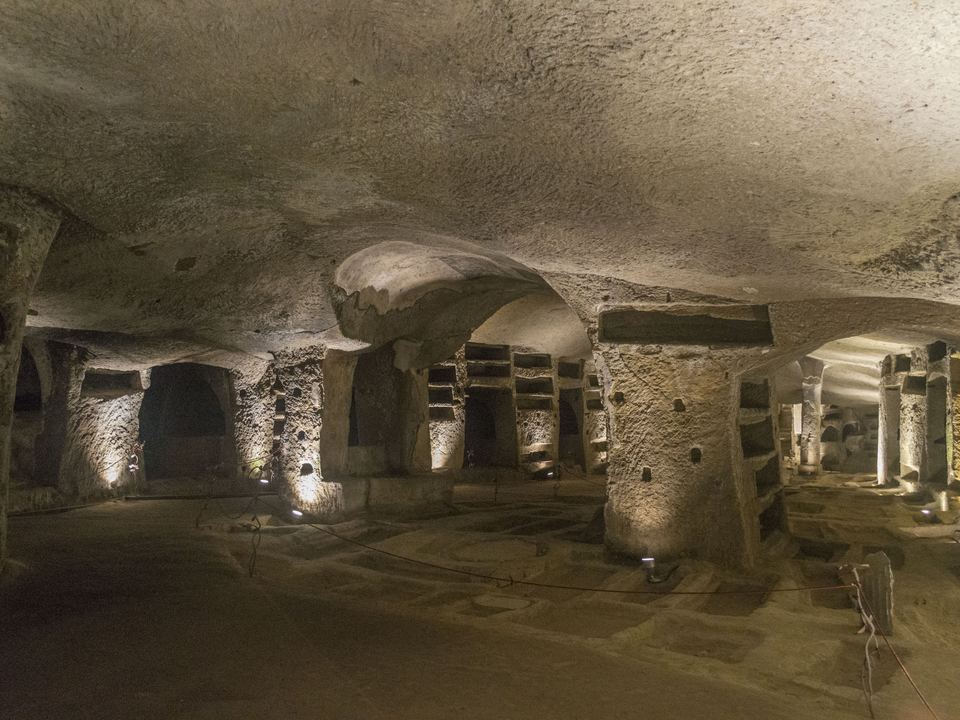
What began, in the second century, as a private burial vault for a single well-off Neapolitan family grew over the following centuries into a sprawling network of galleries and chambers carved from the soft tuff beneath Naples' Sanità hill. The upper level, known as the vestibolo superiore, preserves some of the complex's earliest decoration: vault paintings in a late Pompeian style, populated with pomegranates, garlands and cupids alongside biblical scenes such as Adam and Eve and David and Goliath, evidence that the site served Christian burial customs still steeped in the visual language of its pagan surroundings in its first generations of use.
Everything changed when the relics of San Gennaro arrived on the lower level, drawing bishops and members of the Neapolitan nobility who wished to be buried close to the martyr in the hope of sharing in his protection. Around the tomb grew a basilica-like hall with three aisles hewn directly from the rock, and next to it the so-called bishops' crypt, its barrel vault lined with painted portraits of Naples' earliest bishops — a gallery of faces that makes the catacombs, alongside their role as a cemetery, one of the fullest surviving records of the city's early Christian community.
Did you know?
Among the paintings, art historians point to a portrait of San Gennaro flanked by a girl and a woman, inscribed with the words "Sancto Martyri Januario," as the oldest surviving image of the saint, dated to the second half of the fifth century — decades before he settled into the popular imagination as Naples' protector against Vesuvius itself. In the bishops' crypt, a fifth-century mosaic is thought to depict San Quodvultdeus, a bishop of Carthage who took refuge in Naples after being expelled by the Vandals, a small but telling trace of how the upheavals of the wider Mediterranean could wash even senior clergy up on this hillside.
The catacombs owe their current life not to archaeologists but to a group of young people from the Sanità neighbourhood, who in 2006 formed the cooperative La Paranza together with the local priest Don Antonio Loffredo, determined to turn a site that had been closed for decades into a source of jobs and pride for one of Naples' most stigmatised districts. Trained from scratch as guides, restorers and custodians, the cooperative reopened the catacombs to visitors in 2009, and its success — recognised well beyond Naples — has since become a widely cited case study in heritage-led regeneration.
Good to know
The catacombs can only be visited on a guided tour, run hourly between 10:00 and 17:00 and closed on Wednesdays; the entrance sits beside the Basilica del Buon Consiglio at Via Capodimonte 13. A standard ticket also covers a visit to the nearby Catacombs of San Gaudioso, a short walk away in the heart of Rione Sanità, valid for up to a year after purchase, so there's no need to see both on the same day.
Tours run about an hour, in Italian and English, led by guides drawn from the same cooperative that revived the site, who fold the neighbourhood's own story into the history lesson. It's worth combining the visit with a walk through Rione Sanità itself, past the Palazzo dello Spagnolo and Palazzo Sanfelice with their theatrical staircases and the Ponte della Sanità overhead, rather than treating the catacombs as an isolated stop.