
Monastery of Santa Chiara
- Church & Religious Site
- Price: €5 - €7
- Opening hours: Mon-Sat 09:30-17:30, Sun 10:00-14:30
History
King Robert of Anjou and his second wife, Sancha of Majorca, founded the monastery in the early 14th century as the spiritual and dynastic heart of Angevin Naples, endowing it as a double house shared by Franciscan friars and Poor Clare nuns. Robert's own tomb, raised behind the high altar after his death in 1343, became the largest funerary monument built in the city during the Middle Ages: carved by the Florentine brothers Giovanni and Pacio Bertini, it depicts the king four times over and carries a couplet attributed to his friend Petrarch praising him as a ruler "full of virtue."
The church that generations of Neapolitans came to know was a heavily gilded 18th-century remake, its Gothic bones buried under stucco, frescoes and coloured marble — until an Allied air raid struck it directly on 4 August 1943, and the fire that followed burned for the better part of two days, destroying the Baroque decoration along with most of a 14th-century fresco cycle attributed to Giotto's workshop. Rather than replace what had burned, postwar restorers chose deliberately to strip the church back further still, reconstructing the austere Gothic interior it had before the Baroque remodelling — the building reopened, symbolically, on 4 August 1953, exactly ten years after the bombing.
Did you know?
The church most visitors remember today is therefore not the one Neapolitans worshipped in for two centuries, but essentially a scholarly reconstruction of an even older one — a rare case where wartime destruction pushed a building's appearance backward in time rather than simply repairing what was lost.
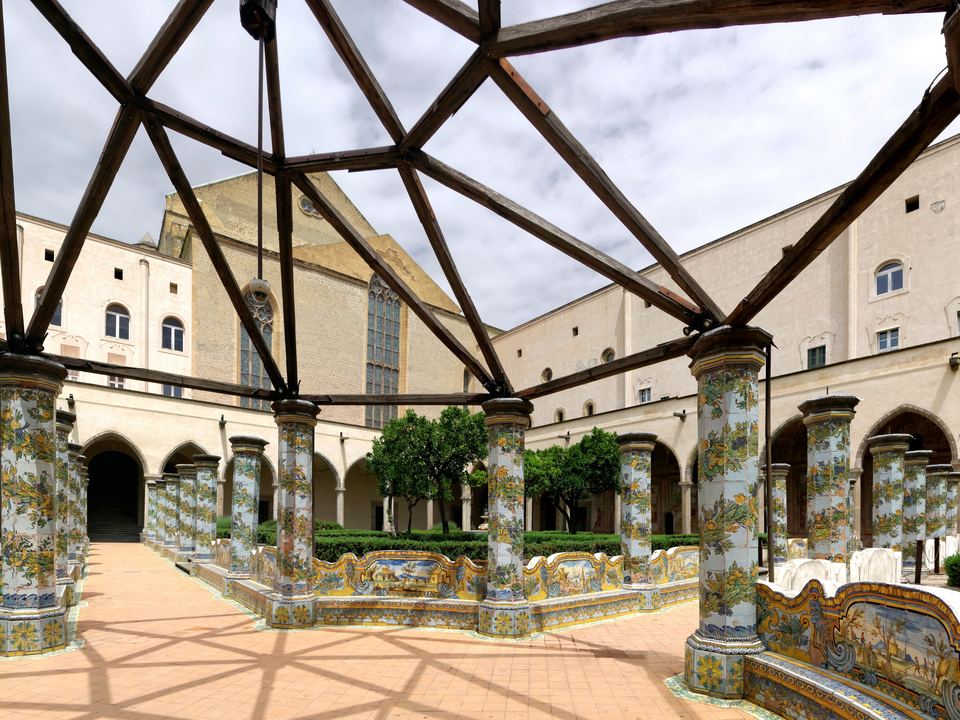
Beside the church, the convent's cloister looks nothing like that solemn interior: architect Domenico Antonio Vaccaro remodelled it in 1739-1742 into a garden crossed by covered walkways, their octagonal columns and matching benches wrapped in majolica tiles hand-painted by brothers Donato and Giuseppe Massa. Look closely and the tiles turn playful — lemon and citron branches, hunting scenes, carnival masks, and vignettes of ordinary 18th-century Neapolitan life wind around pillars meant, at least in part, simply to delight the nuns confined behind the convent walls.
Good to know
The complex keeps shorter hours on Sundays (10:00-14:30) than the rest of the week (Monday-Saturday 09:30-17:30), and a single ticket covers both the majolica cloister and the small museum of archaeological remains uncovered beneath it; the basilica itself can usually be visited separately and free of charge.
Midday sun brings out the majolica's colours best, since the columns and benches sit under open sky rather than deep shade, though the covered walkway around the garden's edge offers relief if visiting in summer heat. The complex is a short walk from both San Domenico Maggiore and the Cappella Sansevero, making it a natural third stop on a Spaccanapoli walking loop.