
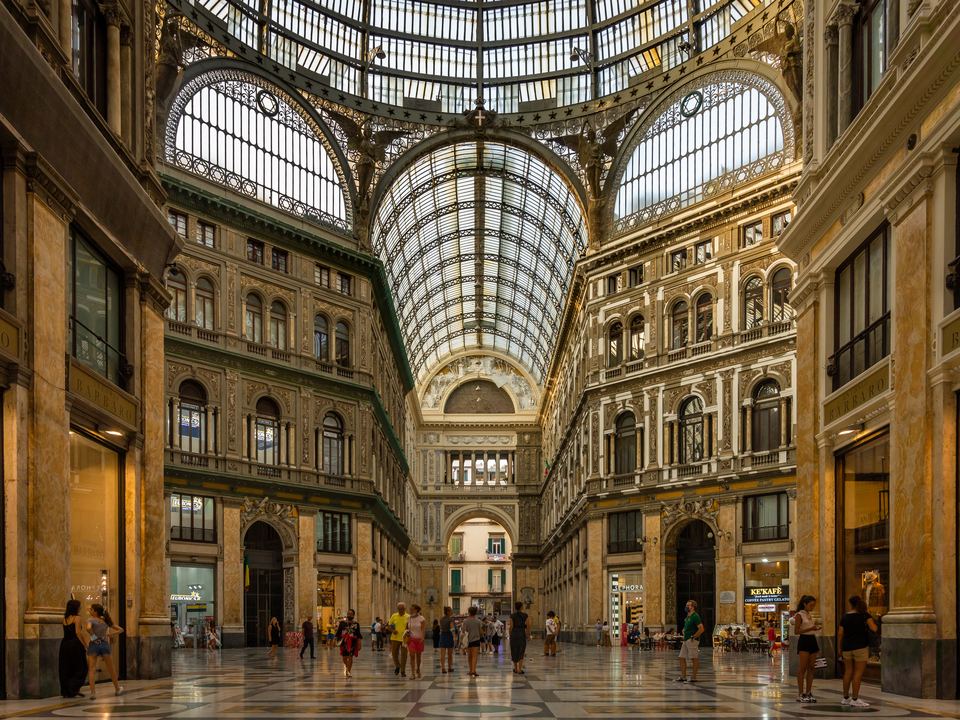
Galleria Umberto I
- Architecture & Design Landmark
- Price: Free
- Opening hours: 05:00 - 24:00
Book a guided tour of Napoli
Skip the line and see Napoli with a local guide.
History
The gallery grew out of the 1885 special law for the risanamento of Naples, the sweeping slum-clearance and rebuilding programme launched after a cholera epidemic had killed thousands in the city the previous year. A design competition was won by the engineer Emmanuele Rocco, whose scheme was then developed by the architect Antonio Curri and further expanded by Ernesto di Mauro; demolition of the old quarter around Santa Brigida began on 1 May 1887, and the first stone of the new arcade was laid that November. Three years of construction followed, and the finished gallery — four glass-and-iron wings meeting beneath its great dome — was formally inaugurated on 19 November 1890, with decorative work and shopfitting continuing into the following year.
Curri, credited above all with the building's sculptural detail, carved the Nereids and Nymphs framing the entrance on Via Santa Brigida and shaped the exedra facing the Teatro di San Carlo across the street. Barely a week after the main inauguration, on 15 November 1890, the space beneath the central dome opened as the Salone Margherita, Italy's first café-chantant, modelled on the cabarets of Paris; performers such as the Spanish dancer Bella Otero and the French Cléo de Mérode took its stage in the years that followed, and it quickly became the after-hours meeting point for the same fashionable Naples that filled the gallery's cafés by day.
Did you know?
Look up at the drum beneath the dome and you'll spot a six-pointed star worked into the ironwork, a detail local guides often link to the city's 19th-century Masonic lodges, several of whose members were involved in financing and building the risanamento-era Naples the gallery belongs to — though, as with most claims of hidden symbolism in a building's decoration, it's a reading that's more atmospheric than documented.
The gallery's Belle Époque glamour did not survive the Second World War unscathed: Allied bombing raids on the city in 1943 tore through the surrounding neighbourhood and damaged the arcade itself, and the original marble floor, inlaid with the mosaic signs of the zodiac and the four winds that still greet visitors underfoot today, had to be relaid during restoration works completed in 1952.
Good to know
There's no admission charge and no fixed closing time for the arcade itself, which functions as a public street open from roughly 5am to midnight; the individual bars, bookshops and boutiques inside keep their own separate hours, generally in line with typical Neapolitan shop opening times, and are busiest in the early-evening passeggiata.
Standing directly across Via San Carlo from the opera house, the gallery makes a natural five-minute link between the Teatro di San Carlo and Piazza del Plebiscito on one side and the Via Toledo shopping street on the other, so it's easy to fold into a single walk between all three. The mosaic floor beneath the dome and the play of light through the iron-and-glass roof are most photogenic around midday, when the sun angles down through the highest windows, or in the evening once the internal lighting comes on.