
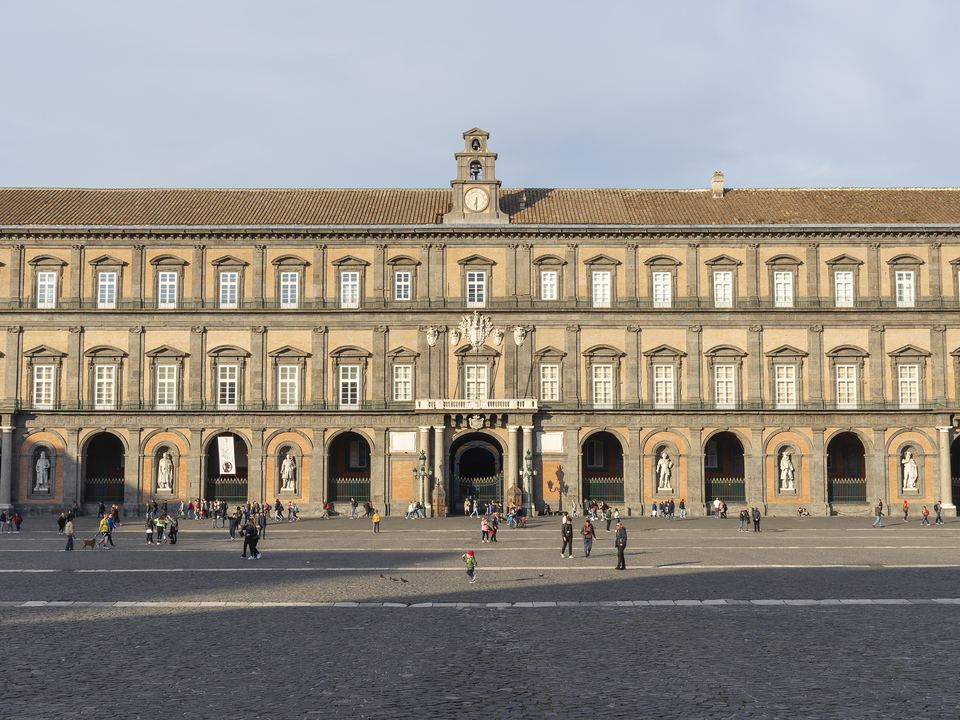
Royal Palace of Naples
- Historic Palace
- Price: €2 - €15
- Opening hours: 09:00 - 20:00 (closed Wed)
History
Vanvitelli's structural fix in 1753-54 gave the palace one of its most recognizable features almost by accident: called in to shore up a facade already showing signs of subsidence, he sealed eight of the original sixteen ground-floor arcade openings, turning them into the blank niches that would sit empty, unfilled, for well over a century. It took a fire — one that broke out in the Queen Mother's apartments in 1837 — to trigger the palace's next great transformation: King Ferdinand II handed the rebuilding to the architect Gaetano Genovese, who spent the following two decades, from 1838 to 1858, reordering the interiors, raising the monumental staircase on the palace's south side, and laying out the Belvedere courtyard and hanging garden that still shape that end of the complex today.
Those empty niches were finally filled half a century later, in 1888, when King Umberto I of the newly unified Kingdom of Italy commissioned eight sculptors from the city's Academy of Fine Arts to carve the statues of past rulers now on the facade — a project that was as much political statement as decoration, presenting the Savoy monarchy as the rightful heir to eight centuries of rule over Naples, Norman kings included.
Did you know?
Tucked into the palace's east wing, the Biblioteca Nazionale Vittorio Emanuele III holds one of Italy's most important collections, and within it a genuinely singular institution: the Officina dei Papiri Ercolanesi, founded in the 18th century by Charles of Bourbon to unroll and study the carbonized papyrus scrolls recovered from a private library buried at Herculaneum by Vesuvius's eruption in 79 AD. The library's holdings today run to around 1,800 of these scrolls, and specialists still work, slowly and painstakingly, to unroll and decipher the ones that have never been opened.
The Court Theatre tucked inside the palace, small and lavishly decorated in Rococo style, was built for an audience of one royal family and its invited guests rather than the paying public that filled the Teatro San Carlo just around the corner — a reminder that, for most of its history, the Palazzo Reale functioned less as a museum-in-waiting than as the fully working nerve center of a kingdom's court life, with its own theatre, chapel and eventually library folded into the same walls as the royal apartments.
Good to know
The palace is open 09:00-20:00 and closed on Wednesdays, with tickets in the €2-15 range depending on which route and exhibitions are included; the Grand Staircase, Royal Apartments and Throne Room form the core visit, and it's worth budgeting an extra half hour if the Court Theatre or Biblioteca Nazionale's reading rooms happen to be open to visitors that day.
Piazza del Plebiscito, facing the palace's long facade, offers the classic photograph of the statue-lined front against the curved colonnade of the Basilica di San Francesco di Paola opposite, best captured in the soft light of early morning before the square fills with people; the Teatro San Carlo and the Galleria Umberto I are both a minute or two's walk away, making this square a natural hub for exploring the rest of central Naples on foot.