
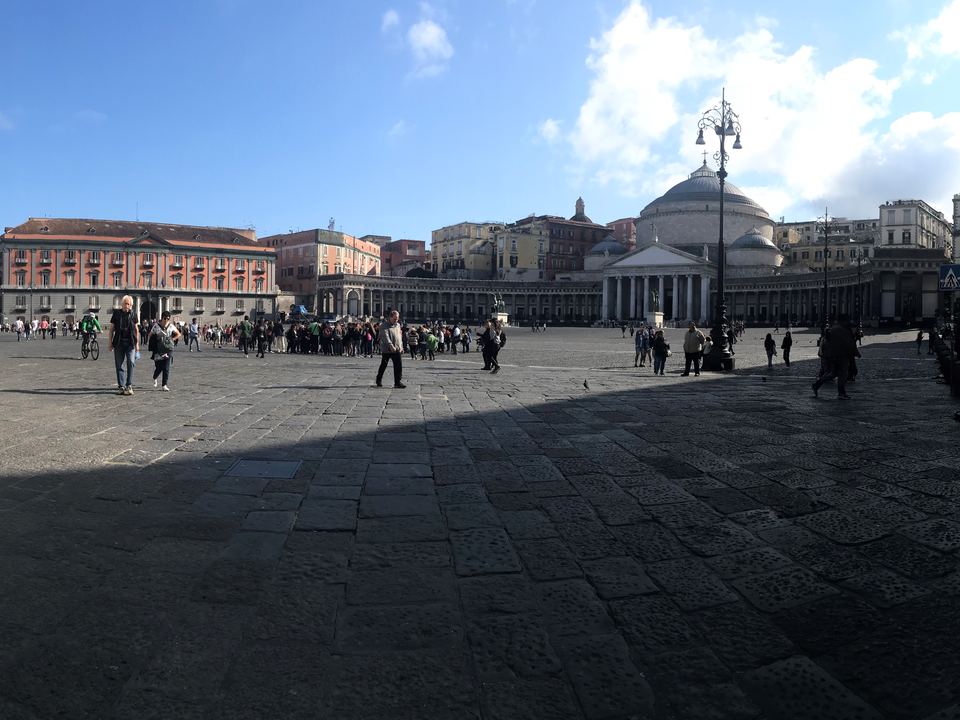
Piazza del Plebiscito
- Square & Avenue
- Price: Free
- Opening hours: Always open
Book a guided tour of Napoli
Skip the line and see Napoli with a local guide.
History
Long before it took its current shape, the site was known simply as the Largo di Palazzo, the open ground the Spanish viceroys left in front of the Royal Palace after Domenico Fontana completed the building around 1600. It stayed a loose, unpaved space hemmed in by convents until 1809, when Joachim Murat, Napoleon's brother-in-law and the French-installed king of Naples, ordered the religious houses cleared to make way for a grand civic forum he planned to name after himself. Murat's scheme called for a vast semicircular colonnade cut into the slope of the Pizzofalcone hill, echoing the great fora of imperial Rome, but his fall from power intervened: deposed in 1815 and executed by firing squad at Pizzo Calabro that October, he never saw the project past its foundations.
It fell to the restored Bourbon king Ferdinand I to finish the work, though on very different terms. In fulfilment of a vow made during his years of exile, he set aside Murat's amphitheatre and instead commissioned Pietro Bianchi to raise a church dedicated to San Francesco di Paola, its Pantheon-like dome and 38-column colonnade completed in 1846 after three decades of on-and-off construction. The two bronze equestrian statues standing in the open square before it were no less dynastic in intent: Antonio Canova, the leading sculptor of the age, modelled the horse of Charles III before his death in 1822, leaving his pupil Antonio Calì to finish the rider and to sculpt the companion statue of Ferdinand I entirely on his own.
Did you know?
Local tradition holds that Queen Margherita of Savoy, visiting the square in the late 19th century, granted an unusual privilege to prisoners held in the city: those who could walk the roughly 170 metres from the Royal Palace to the equestrian statues blindfolded, and pass exactly between the two horses, would earn a royal pardon. As the story goes, almost nobody managed it — the vast open pavement offers no tactile cues for keeping a straight line, and visitors who try the same blindfolded challenge for fun today still tend to veer well off course and end up nowhere near the statues.
Had history gone differently, Neapolitans might still be calling this square the Foro Murat, after the French king who first cleared the ground: work on his semicircular forum had barely begun when the Bourbons returned and redirected the whole site toward Ferdinand's votive church instead. The square only took the name it carries today after 1860, when Naples voted in the plebiscite to join the newly unified Kingdom of Italy under Victor Emmanuel II.
Good to know
The square itself is open around the clock and costs nothing to cross, and since 1994 — when the city closed it to traffic ahead of that year's G7 summit — it has been entirely pedestrian, a rarity for a space this size in central Naples. The Basilica di San Francesco di Paola on its western side keeps its own separate hours, open to visitors for Mass and quiet viewing through the day, while the Palazzo Reale opposite operates as a ticketed museum with its own timetable.
The piazza is Naples' default venue for anything that needs room for a crowd, from the free open-air concert that draws thousands on New Year's Eve to football victory celebrations and public gatherings of every kind. It sits within a few minutes' walk of the Teatro di San Carlo, the Galleria Umberto I and the seafront at Via Partenope, making it a natural hub for a day of walking in the historic centre, and the warm evening light over the colonnade, once the crowds thin, is when the square photographs best.