
Certosa e Museo di San Martino
- Historic Site
- Museum
- Viewpoint & Tower
- Price: €2 - €6
- Opening hours: 08:30 - 18:30 (closed Tue)
History
Charles of Anjou-Calabria, son of King Robert the Wise, entrusted the design to Tino di Camaino, the Sienese sculptor-architect then also active nearby at Castel Sant'Elmo; when Tino died in 1336, his pupil Attanasio Primario took over direction of the works with Giovanni de Bozza, and the Carthusian monks — who prize silence and solitude, living largely apart from one another around a great cloister — took possession of the site the following year, even though the church and complex weren't formally consecrated until 1368, under Queen Joanna I.
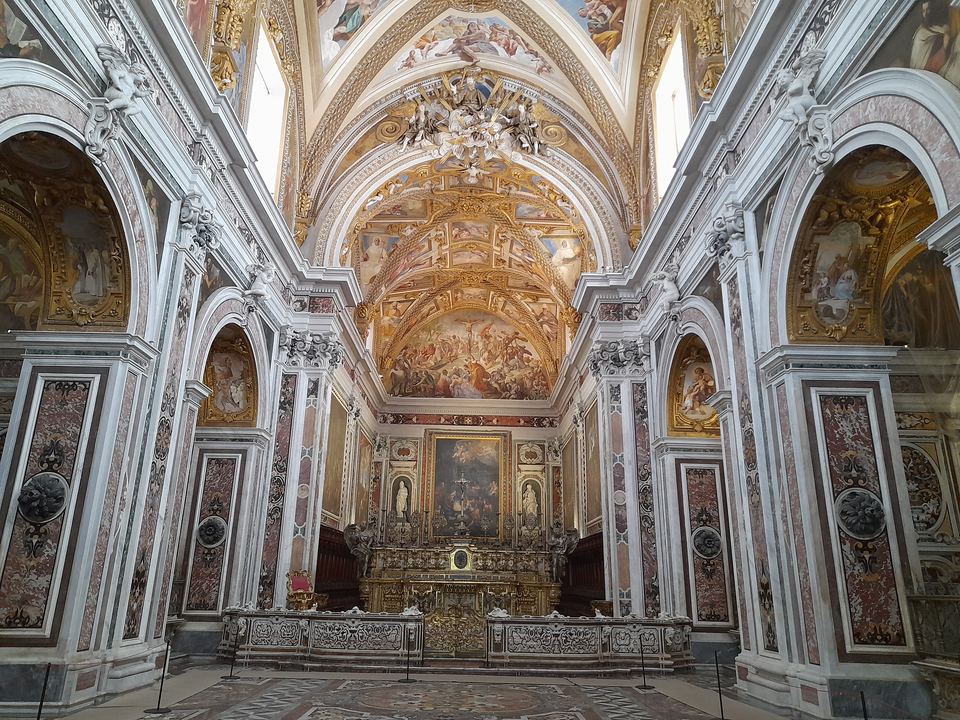
Fanzago's Baroque transformation, launched in 1623, remade the Gothic shell inside and out, but the monastery's fortunes turned during the political turmoil of 1799: suspected of republican sympathies during the French occupation, the Carthusian community was suppressed, and although the monks returned briefly after 1804, they left the Certosa for good within a few years, after which the complex served for a time as a military hospice for war veterans before eventually being reborn as a museum.
Did you know?
The Presepe Cuciniello, the nativity scene that gives the museum its best-known room, isn't a medieval or even Baroque survival — it's a 19th-century creation. The architect, playwright and collector Michele Cuciniello spent years assembling roughly 800 figures, animals and miniature accessories, many crafted in the traditional 18th-century Neapolitan style, before donating the whole collection to the state and personally overseeing its installation inside a former kitchen of the monastery, reshaped into an artificial grotto; it was unveiled to the public on 28 December 1879 and has barely changed since.
Cuciniello arranged his figures across three connected scenes rather than a single tableau: the Nativity itself set among the ruins of a pagan temple, a raucous tavern scene full of everyday Neapolitan characters, and the angels' announcement to the shepherds on a hillside — and a hidden lighting system still cycles slowly through dawn, midday, sunset and night to change the mood of the grotto as visitors watch.
Good to know
The Certosa is open 08:30-18:30 and closed on Tuesdays, with tickets priced in the €2-6 range; because it shares its hilltop with Castel Sant'Elmo barely 200 metres away, the two sites are easily combined in one visit and reached the same way, via the Funicolare di Montesanto to the Morghen stop or the Funicolare Centrale to Piazza Fuga.
Beyond the Presepe Cuciniello, the quadreria's paintings and historical views of Naples reward a slower visit, but don't skip the terraced gardens beside the great cloister — the view over the rooftops to the bay and Vesuvius rivals the one from Sant'Elmo's ramparts, and with far more greenery in the foreground, it often makes for a more flattering photograph in the late afternoon light.