
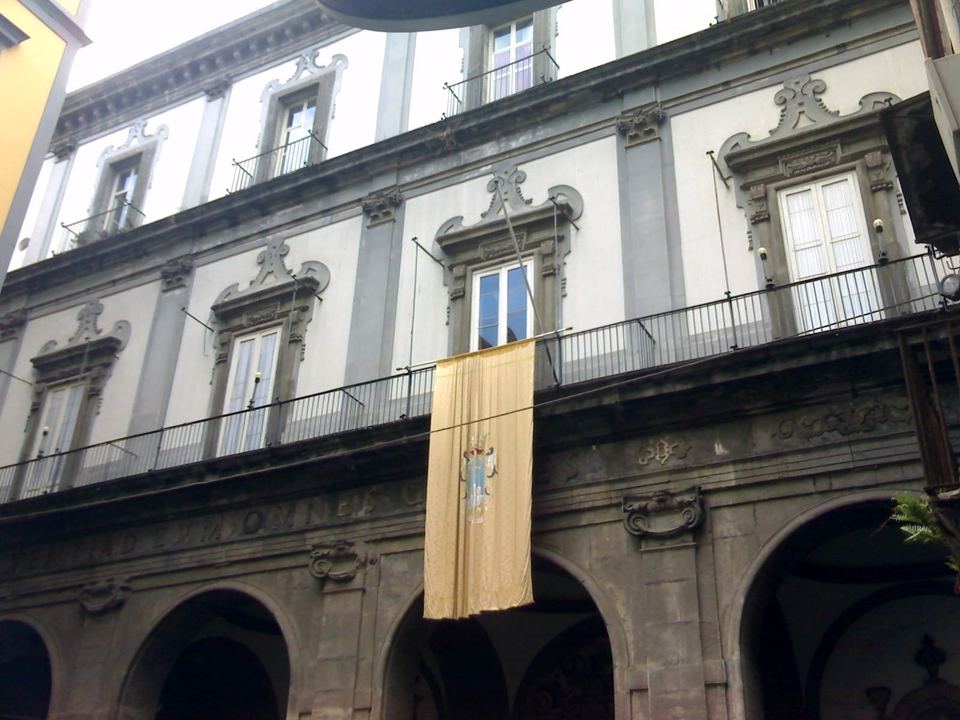
Pio Monte della Misericordia
- Art Museum & Gallery
- Church & Religious Site
- Price: €8 - €10
- Opening hours: Mon-Sat 10:00-18:00, Sun 09:00-14:30
History
In 1601, seven young Neapolitan noblemen — among them Cesare Sersale and Giovan Battista Manso, later a friend and patron of the poet Torquato Tasso — began meeting on Fridays at the Hospital for the Incurables to bring food and comfort to the sick. Their informal charity grew quickly enough that within about a year it was formally constituted as the Pio Monte della Misericordia, and building began on a dedicated octagonal church, completed to a design by architect Francesco Antonio Picchiatti — who took over after Cosimo Fanzago turned the commission down — between the 1650s and 1670s.
Caravaggio arrived in Naples in October 1606, a fugitive from Rome after killing a man in a brawl, and within months had landed the young confraternity's most consequential commission. Rather than paint the seven acts of mercy as separate panels as originally planned, he compressed all of them, along with the Madonna and Child looking down from above, into a single dense, shadow-drenched canvas; he was paid 400 ducats for The Seven Works of Mercy on completion in January 1607, and it has hung above the high altar, largely undisturbed, ever since.
Did you know?
The Seven Works of Mercy is one of the vanishingly few major Caravaggios still in the exact spot it was painted for — in over four centuries it has left the church only a handful of times, and always briefly, for restoration or a major loan exhibition. That permanence is part of what makes the painting so admired by specialists: it can still be studied in the light and at the height Caravaggio himself designed it for, rather than reconstructed from a museum wall.
Squeezing all seven acts of mercy — feeding the hungry, giving drink to the thirsty, clothing the naked, sheltering pilgrims, visiting the sick, visiting prisoners and burying the dead — into one canvas was considered a nearly impossible brief at the time, and Caravaggio solved it by having single figures do double duty: an innkeeper gesturing a pilgrim inside also shelters the homeless, and a young man sharing his cloak with a beggar stands in for two separate acts at once, a compression of storytelling that later painters studied and rarely matched.
Good to know
The church and picture gallery keep shorter hours on Sundays, when Mass takes priority, so a Monday-to-Saturday morning visit gives the most unhurried time in front of the Caravaggio. A single ticket covers both the ground-floor church and the upstairs gallery of Neapolitan Baroque paintings, which is usually far quieter than the room below.
Because the charity is still an active, working institution rather than a museum piece, part of the ticket price continues to fund the same kind of hospital, prison and poverty relief the seven founders set out to provide in 1601. The site sits only a few minutes' walk from the Duomo and San Gennaro's Treasure Chapel, making it easy to combine into the same morning along Via Duomo.